Since I work with the best counterpart organization in Peace Corps Ecuador, two weeks ago I got a free 7-day trip to northern Peru. Granted this was no luxury retreat but free nonetheless!
Rather than bore you with the details here’s a quick summary of the trip in bullet form!
- Departure with 102 F fever. 5-hour journey to the border on winding mountain roads. Time to bring in the Swiss engineers to build Ecuador a few tunnels. :)
- Arrival at the border. Make what I think is some sort of shady deal with Peruvian immigration agent to allow our car to cross the border without the renewal of some paperwork.
- Feeling a bit better. Stop for Peruvian ceviche in the sort-of coastal city of Piura. Amazing! Huge 2.5 foot long platter filled with lobster, crab, shrimp, fish, clams, etc. Mystery white drink appears on table. Seeking refreshment, I take a big gulp. Eww! Turns out to be warm, salty fish broth. Luckily next comes the Chicha Morada, an ice cold, deep purple drink made from purple corn typical of the region (tastes just like purple Kool Aid)
- Piura is sweltering and the streets are buzzing with moto-taxis – motorcycles chopped in half with two seats in back for passengers, rickshaw style. Meetings are held at the Piura office of my organization for the rest of the day and part of the following day, and I’m drenched in sweat from the fever and the climate. Dengue Fever is a huge problem in the area, and the municipality is coming to individual homes to fumigate for mosquitos. I keep my fingers crossed that the Dengue mosquitoes don’t like the taste of gringo skin!
- I head to a local pharmacy and tell the woman that I’m not well. She cuts three mystery yellow pills from a blister pack, pops them in a little baggie and I head out. No questions, no prescription. Hopefully they’re not cyanide.
- In Piura I room with the Administration guy from my office and a fan/window war ensues throughout the night. Room is 95 degrees and feels like 120 with my fever. I turn on the fan, he turns it off, I turn it on, he turns it off... Bed is soaking wet from my sweat and I begin to do yoga breathing to calm down. How he is cold is beyond me! Grr! Luckily I wake up in much better condition. The mystery yellow pills worked! (Or I could have just sweat out the sickness during the night as my grandfather used to do… double shot of whiskey + electric blanket = new person in the AM)
- From Piura a two-day driving trek follows to the city of Chachapoyas, located in the Amazonas region of Peru. Scenery is totally different than Loja. Flat, scrub brush and pretty dry. Farmers growing passion fruit everywhere and living in homes built of mud and tree branches. We stop for the night in the town of Olmos, which “olmost” looks like a war zone to me. A gringa approaches at the hotel and it turns out to be her Peace Corps Peru site! And, I had already met her once at a Hanukkah party when she was traveling through Ecuador. Small world!
- Finally arrive in Chachapoyas after traveling on a crazy road through a high-walled canyon with a rushing river. Chach, as I will call it from this point on, is actually really nice. Lots of old Spanish architecture and history. We stay at an old Spanish home turned hotel for three nights. We have a few meetings at my organization’s Chach office.
- On the bumpiest dirt road ever, we head to check out a site that my organization is looking to conserve, which is highly threatened by encroaching cattle farmers. It’s a high-altitude palm forest, one-of-a-kind, and they already identified two new species of palms previously unknown to man.
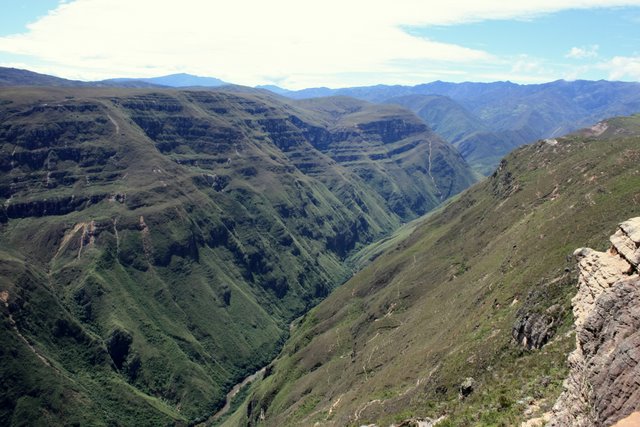
- Next day involves lots of site seeing. The Chachapoyan people lived in this area for hundreds of years before being taken over by the Incans, and finally the Spanish, and many ruins have been found. We visit the Kuelap archaeological site (another dirt road on the side of a mountain for several hours to get there), some other archaeological sites I can’t remember, the Gocta waterfall – fifth highest in the world, some museums, some mummies, and the 3300 ft deep Sonche Canyon. Neat stuff.
- Finally, we make the journey back to Loja, which takes another two days. After 8 hours of driving on all dirt roads, I think some pieces of my brain have come loose and are now rattling around in my brain. The border crossing we take this time (south of the Ecuadorian city of Zumba) is seldom used and is basically a guy that needs to go look for the key to unlock the gate so we can drive across the bridge. The road here is full of potholes and not much more than a car width wide with thick jungle vegetation sprouting into the roadway. The occasional pineapple stand is a welcome break.
- When we hit the pavement about an hour and a half south of Loja, it’s like heaven. So smooth and wonderful. My head slowly begins to recover and the familiar sites of Loja soon appear. I enter my apartment, hit my bed, and sleep for the next 14 hours straight!
Enjoy the photos... lots of them this post.
Moving - The Peruvian way.
Scrub brush landscape
The town of Olmos - a Peace Corps Peru site
Porcuya Pass - The lowest pass in the Andes that crosses the continental divide
Mmm... roadside arroz con pollo for sale during a construction roadblock
Construction crews using mules to carry equipment down the mountainside
Roadside adobe homes
My bird obsessed counterpart scanning the mountains during another roadblock
Chachapoyas at night
Chach Church
Chach Street
Chach buildings
Chachapoyan mummies! They were buried in this position. The one on the left still has hair!
A demonstration of the Peruvian dance called the
Marinera, sometimes done with a horse "dancing" as well
And then they decide to pull me into the mix!
Checking out the Chachapoyan nightlife
The Sonche Canyon - over 3000 ft deep
The palm forest that we're trying to conserve. All those trees in the distance are palms.
Local settler near the palm forest
The road to the Kuelap ruins. Note hair pin turn to the right with no guardrails!
Inside Kuelap. There are over a hundred of these circular homes remaining.
Our 16 year old tour guide!
My counterpart amongst the ruins
House in excellent condition with reconstucted roof. The Chachapoyans used this diamond design in much of their art and architecture.
One of only three entrances to the Kuelap complex. Only one person could fit through at a time for security reasons.
Rock engravings
They could see anyone coming for a long ways
The Gocta Waterfall - Fifth highest in the world. Unfortunately is was extremely dry and there wasn't much water.
No McDonald's or Dunkin' Donuts out here! Instead freshly picked pineapples are the common roadside snack.
This happy guy liked getting his picture taken and seeing it on the screen while his mom cut up a pineapple for us.
The slow and bumpy ride home. Just one of many obstacles we encountered.